
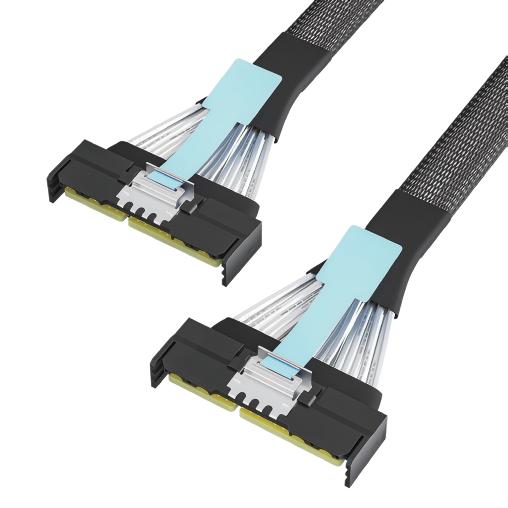
The landscape of high-performance computing is shifting. As we push the boundaries of AI, machine learning, and data analytics, the demand for bandwidth has skyrocketed. PCIe Gen 5, with its blistering 32 GT/s data rate, has arrived to meet this challenge. However, with great speed comes great responsibility—specifically, the responsibility of maintaining signal integrity and system density. Enter MCIO (Mini Cool Edge IO), the connector standard engineered to unlock the true potential of PCIe Gen 5 and beyond.
Why MCIO is the New Standard for High-Speed Interconnects
As PCIe speeds double, the physical interconnect becomes a critical factor in system performance. Legacy connectors simply weren't designed for the 32 GT/s signaling rate of PCIe Gen 5 . MCIO was purpose-built to solve these challenges, offering a robust foundation for next-generation servers and storage
-
Superior Signal Integrity: MCIO connectors are engineered with shorter electrical paths, tighter impedance control, and improved differential pair isolation. This design minimizes insertion loss, reflections, and crosstalk, ensuring that the signal remains clean and stable even at the demanding PCIe Gen 5 (32 GT/s) and future Gen 6 (64 GT/s) speeds.
-
High-Density Design: Space is at a premium in modern rackmount and edge systems. MCIO supports x4, x8, and x16 lane configurations in a remarkably compact footprint. This allows architects to aggregate more lanes per connector, reducing overall connector count and freeing up valuable PCB real estate.
- Thermal and Airflow Efficiency: By enabling high-bandwidth consolidation into fewer, thinner cables, MCIO reduces cable clutter. This significant reduction in obstruction dramatically improves airflow across critical components like CPUs, GPUs, and heat sinks, which is vital for thermal management in dense 1U and 2U chassis.
The Flexibility of MCIO X16: From CPU to Backplane
The true power of the MCIO x16 interface lies in its versatility. It serves as the ideal building block for a wide range of applications, from internal server connections to complex, scalable architectures. Whether you need to connect a CPU to a backplane, a NIC card, or a riser, MCIO provides a cleaner, higher-performing channel than traditional PCB traces. Its ability to handle multiple protocols—including PCIe, NVMe, and SAS—allows for standardization across diverse platforms, simplifying manufacturing and service.
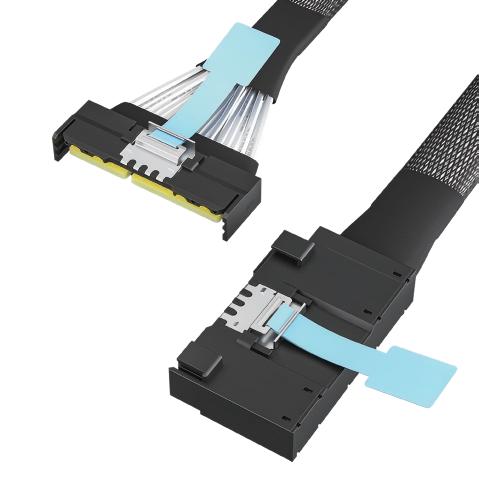
Real-World Application: Building a Modular PCIe Gen5 Ecosystem
The true magic of MCIO x16 happens when it's paired with intelligent switching and bridge technology. Products like the HighPoint MCIO-PCIEX16-G5 Bridge Card exemplify the modular revolution.
Imagine a system where you are not limited by the physical slots on your motherboard. By leveraging HighPoint’s Rocket Series PCIe Gen5 Switch Adapters, you can create a centralized switch fabric using MCIO connectivity. The MCIO-PCIEX16-G5 acts as the critical link, converting two high-density MCIO 8i ports into a full-sized PCIe 5.0 x16 slot.
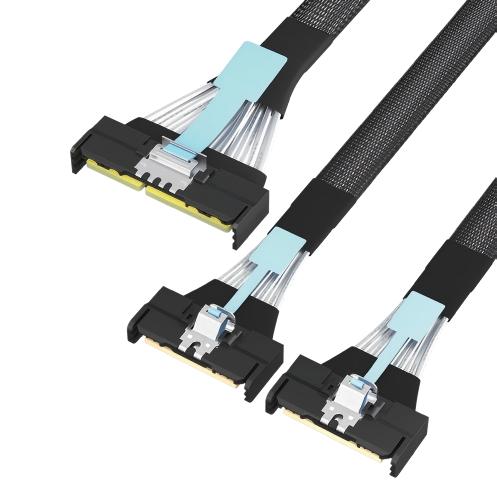
This capability transforms how you design systems. You can now:
-
Integrate NVIDIA GPUDirect Storage: Seamlessly connect compute and NVMe storage through a single adapter, creating a unified, high-bandwidth pipeline for AI and HPC workloads.
-
Scale Accelerator Power: Easily add additional GPUs, FPGAs, or other PCIe Gen5 I/O devices for AI training, edge inference, and multi-GPU rendering without being constrained by motherboard topology.
-
Guarantee Dedicated Bandwidth: With non-blocking PCIe switching technology, each MCIO x8 port can deliver up to 64 GB/s of dedicated throughput, preventing I/O contention and ensuring predictable performance for data-intensive applications.
Future-Proofing with MCIO
Investing in MCIO-based infrastructure is a strategic move for the future. While it is the ideal solution for today"s PCIe Gen 5 challenges, its electrical characteristics are designed to scale. As we look toward PCIe Gen 6 and the adoption of PAM4 signaling, MCIO provides the necessary headroom and margin to adapt without a complete connector redesign.
For system integrators, OEMs, and enterprise IT teams, the message is clear: MCIO X16 is more than just a new connector; it is the foundation for a new era of flexible, high-performance, and scalable computing architectures. From dedicated NVMe storage arrays to dense GPU clusters, MCIO is the key that unlocks the future of data-centric computing